
Yosemite Has No Reservation System This Summer, and the Lines Are Already Brutal
By Cap Puckhaber, Reno, Nevada
What Dropping the Reservation Did to the Entrance Gates
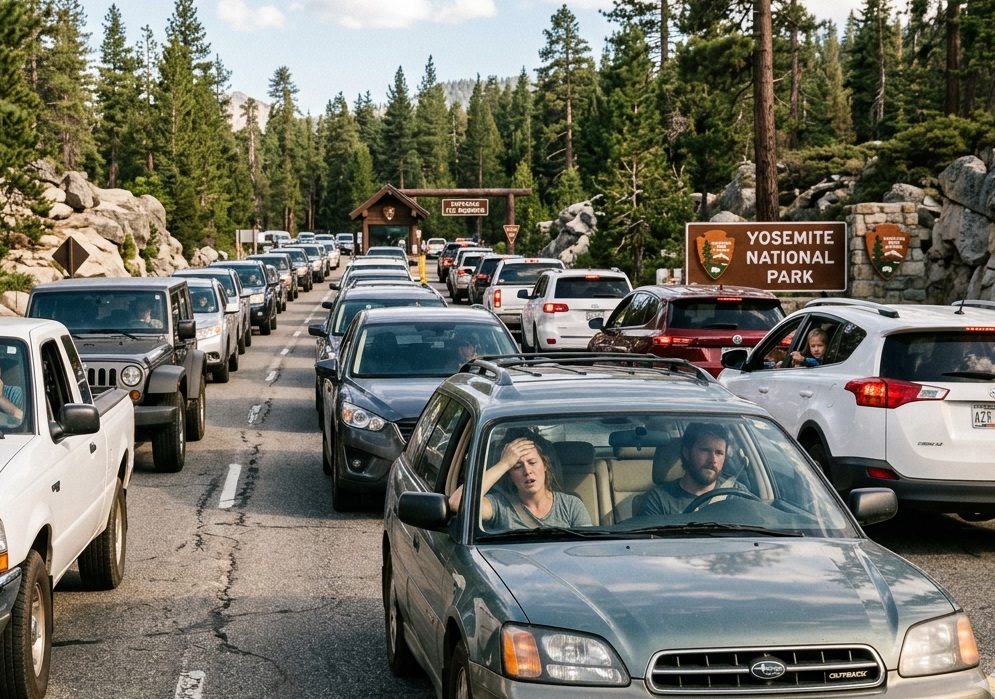
I watched this coming from a mile away. When the National Park Service announced it was dropping the timed entry system for Yosemite, my first thought was not freedom or celebration. It was flashback. Specifically, the kind of gridlock I remember from summers past, when you could sit bumper-to-bumper on Highway 41 with El Capitan somewhere in the distance and zero inches of forward movement.
That feeling turned out to be exactly right. The first big weekend of the season, on May 2, parking lots in Yosemite Valley reached capacity before 11 a.m. Visitors reported 90-minute traffic delays at the south entrance on Highway 41 alone. The Hetch Hetchy overflow lot, which people use as a fallback, was also full by midday. Cars were squeezed onto dirt shoulders, curbs, and between trees in ways that would have made a ranger wince.
This is not a rare bad day. It is the predictable consequence of removing a throttle from one of the most visited patches of land in the Western hemisphere. Yosemite drew 4.27 million visitors during its most recent full year with a reservation system in place. Without one, the park does not get fewer people. It gets the same crowd with no way to pace them.
What the Data Actually Showed When Reservations Were Last Dropped
The NPS removed the timed entry system once before, back in the summer of the heavy overcrowding period. Wait times at the entrance stations stretched to nearly three hours on peak days. A visitor survey from that same season found that 51 percent of visitor groups reported being negatively impacted by parking congestion. An additional 26 percent said crowded restrooms and visitor centers hurt their experience.
The park’s own 224-page management report described the season as one with “long lines at entrance stations and increased strain on the park’s employees, resources, and infrastructure.” That language does not come from a casual data point. It comes from a formal analysis used to justify bringing the reservation system back in the following season. Reservations returned and held for two straight years before the current rollback.
The difference between a park with managed entry and one without it is not subtle. Outside Online documented firsthand reports</a> from park employees who predicted that the traditional Saturday madness would become an everyday occurrence as summer heat and school breaks push July visitation toward its historical peak of more than 624,000 visitors in a single month.
Why the NPS Made This Call Anyway
Yosemite Superintendent Ray McPadden pointed to weekday parking data from the prior reservation season to support the change. On most weekdays, lots maintained capacity and traffic moved at a reasonable pace. That part is accurate. The reservation system did work well at smoothing out the mid-week experience when most people were not trying to visit at the same time.
But Yosemite’s crowding has never been a weekday problem. It has always been a weekend and holiday problem. July alone sees more than 600,000 visitors, with the heaviest concentration on Saturdays. Removing a system that worked on the days it was needed most, based on data showing it was unnecessary on the days it was never needed, is a disconnect worth understanding before you pack your car.
The current management strategy replaces reservations with real-time traffic monitoring, active parking management, additional staffing at key intersections, and visitor alerts via text. You can sign up for those alerts by texting “Yosemite” to 33311. That is genuinely useful information. But none of those tools stop a car from entering the park the way a reservation requirement does.
The Shunt System and What It Means for Your Day
Yosemite Valley has a traffic management protocol called the shunt. When parking in East Yosemite Valley fills up, rangers close access to that section and divert day-use vehicles at the El Capitan Crossover intersection. You cannot get in until spaces open. During the last full season without a reservation system, the shunt activated on nearly every Saturday in summer. On some days, it began as early as 8:20 a.m.
That means if you arrive at 9 a.m. on a Saturday with no advance planning, you may be sitting outside the valley floor for several hours with no clear timeline for when you will be let through. You are not turned away from the park entirely, but you are also not going anywhere. The shunt is not a reservation system. It is a frustration system that waits for the problem to happen and then reacts to it rather than preventing it.
The Real Wait Time Picture for Summer
Based on what has already happened in the first weeks of the open-access season and what the data from previous open-access summers shows, here is a realistic breakdown of what to expect at the entrance stations.
Weekday arrivals before 8 a.m. see an entrance wait of 15 minutes or less in most cases. Parking in Yosemite Valley is available for the first few hours of the morning. Conditions hold reasonable if you commit to that early window.
Weekday arrivals between 9 a.m. and 2 p.m. run into waits of 30 to 45 minutes at the gate. Valley parking fills by late morning on most days, and shuttle dependency increases sharply once lots close.
Weekend arrivals before 7 a.m. represent the only window where a weekend visitor can reliably expect parking and a minimal gate delay. Waiting until 8 a.m. on a Saturday is already a gamble. Showing up at 9 a.m. puts you squarely in the worst traffic band of the day.
Weekend arrivals after 9 a.m. during peak summer regularly see waits from 90 minutes to three hours at busy entrance stations. Valley lots reach capacity before noon. The shunt may be active, meaning East Valley access is blocked entirely until turnover frees spaces.
Holiday weekends add an additional 30 to 60 minutes to all of those estimates. NPS data shows July averages more than 624,000 visitors in a single month, the highest of any month across a decade of records, and those numbers are still climbing.
The Travel confirmed what park workers predicted</a> when they reported that, on the first major weekend of the current season, parking lots hit capacity before 11 a.m., some entrance booths were left unstaffed with signs directing visitors to pay on exit, and the south entrance on Highway 41 had 90-minute backups by mid-morning.
How I Plan My Yosemite Visits to Avoid All of This
Cap Puckhaber has been navigating these parks for two decades. The strategies I use are not complicated, but they require real commitment to timing.
The 6 a.m. Rule
If I am driving into Yosemite Valley on a weekend or holiday, my car is at the entrance station no later than 6 a.m. Not a suggestion. This is the hard line. Arriving at 7 a.m. still works on most weekends. Arriving at 8 a.m. means you are gambling. While arriving at 9 a.m. means you are almost certainly waiting in a shunt or sitting in a gate line.
The 6 a.m. arrival gives you the valley at its quietest and most beautiful. Mist still hangs over the meadows. Light hits Yosemite Falls at a slant that does not exist by 10 a.m. You get two to three hours of exploration before the first wave of day visitors pushes through. By the time the parking lots start filling, you are already on a trail.
The Tuesday and Wednesday Window
Saturdays are the worst day to visit Yosemite right now without a reservation system. Fridays and Sundays are close behind. If your schedule allows any flexibility at all, shifting your arrival to a Tuesday or Wednesday cuts the gate wait by half and the parking stress by much more than that. NPS visitation data shows June weekday counts running at roughly 60 percent of weekend counts. That difference is enormous when you are competing for 900 parking spaces in Yosemite Valley.
The YARTS Option Is Underused
The Yosemite Area Regional Transportation System runs buses from Merced, Mammoth Lakes, Sonora, and Fresno directly into the valley. If you board in Merced, the ticket is around $20 and the bus runs multiple times per day. Critically, you do not need a parking spot because you are not driving one. Your entrance to the park is covered by the ticket cost. You step off the bus at the Yosemite Valley Visitor Center and walk straight into the valley without touching a steering wheel.
I have used YARTS on high-traffic summer days and cut my total transit time from the equivalent of four hours of driving, waiting, and circling for parking down to a 90-minute bus ride with a guaranteed drop-off. That is not a marginal improvement. It is a fundamentally different experience of the same park. The bus also frees you to look out the window at the canyon walls as you enter instead of watching the bumper of the car in front of you. People who have taken YARTS at least once almost never go back to driving on peak days. Once you experience arriving stress-free, the idea of fighting a parking lot becomes genuinely unappealing.
Skip the Valley on Peak Days
Yosemite is not Yosemite Valley, even though most visitors treat it that way. Tuolumne Meadows sits at 8,600 feet and has its own trailheads, parking areas, and scenery that rivals anything on the valley floor. Wawona in the south has the Mariposa Grove of Giant Sequoias and significantly lighter traffic. Hetch Hetchy, once called the “other Yosemite Valley” by John Muir, rarely draws crowds anywhere near the volume of the main valley.
I once spent a full day at Hetch Hetchy and saw fewer than 40 other visitors. The reservoir is stunning, the trail to Wapama Falls is excellent, and I had parking without circling once. Getting there required only a willingness to drive an extra 30 minutes from the Big Oak Flat entrance.
What This Means if You Have Trips Already Booked
If you have lodging or camping reservations inside the park, you do not need to change your plans. Visitors with existing overnight reservations at any Yosemite lodging or campground still enter the park without any additional permit requirement. Your reservation for lodging is your access credential. The crowding problem is concentrated entirely on day-use visitors arriving without a spot to park or a place to stay.
If you have lodging booked in gateway towns like El Portal, Mariposa, or Groveland, the math changes somewhat. You will be driving in each day as a day-use visitor, which puts you in competition with everyone else at the gate. The strategies above apply. Getting there early matters more than which entrance you use.
For anyone who has not yet committed to a trip and is considering Yosemite this summer, my honest recommendation is to either book overnight lodging inside the park, take YARTS in, or target a Tuesday through Thursday arrival window. Showing up on a Saturday at 10 a.m. with no plan beyond “we’ll figure it out” is a recipe for a grim experience that feels nothing like what the park actually has to offer.
Half Dome and the Permit System Still Matters
One thing the reservation rollback did not touch is the Half Dome permit system. You still need a permit to hike past Scout Lookout on the cables route. Seasonal lottery applications close in March, but a daily lottery runs two days in advance for slots that open due to cancellations. Cap Puckhaber wrote in detail about national park permit systems, lottery strategies, and which hikes require advance planning in a companion guide to national park reservations. That post covers Yosemite’s permit landscape beyond the entrance gate debate, including specifics on Zion, Acadia, and Rocky Mountain.
The Bigger Argument Behind the Gate
There is a genuine philosophical disagreement underneath all of this that is worth naming plainly. One side holds that national parks belong to every American and that any system requiring advance planning effectively locks out spontaneous or lower-income visitors who cannot spend hours online refreshing Recreation.gov at 8 a.m. on the first day of reservation releases. That is a real concern, and it deserves honest engagement.
The other side points to the data showing what actually happens without managed entry. Trails get compacted. Wildlife corridors get disrupted. Meadow vegetation gets trampled. The visitor experience degrades for everyone, and the people who suffer most are the ones who drove the farthest and waited the longest at the gate.
I do not think this is an argument with an obvious correct answer. What I do think is that the burden of the current approach falls directly on the individual visitor in a way that a reservation system did not. When reservations existed, you did the hard work upfront on a laptop. Without them, you do the hard work in real time in a car on a highway. Neither is consequence-free. One is just much harder to recover from once you are already there.
So the practical advice is simple. Since the park is not going to manage entry for you right now, you have to manage it yourself. Plan your day like a logistics problem, not a leisure decision. The park will reward that level of preparation with an experience that genuinely holds up to every photograph you have ever seen of it.
What to Do Right Now If You Are Planning a Trip
Text “Yosemite” to 33311 before you leave home. Sign up for real-time parking and road alerts. Check the NPS conditions page at nps.gov/yose the morning of your visit. If the alerts are already showing full lots, that is your signal to delay your arrival by a day or to take YARTS.
Buy your park entrance pass digitally through Recreation.gov in advance. Visitors with a digital pass may qualify for priority lanes at certain stations. Pay the $35 per vehicle entrance fee or show your America the Beautiful annual pass at the gate. Cash is not accepted.
Plan your hikes around trail capacity, not just trail interest. The Mist Trail to Vernal Fall is closed Monday through Thursday from late June through late October for repairs. Weekend visitors can hike it freely, but weekday hikers must start by 5 a.m. to clear the closure window. That is not a casual commitment. The Valley Loop trails near Yosemite Falls and El Capitan Meadow are excellent alternatives for visitors who cannot hit that 5 a.m. start.
Keep your expectations calibrated. Yosemite without a reservation system is still Yosemite. El Capitan still stands 3,000 feet above the valley floor. Bridalveil Fall still drops 620 feet into the meadow. Mirror Lake still reflects the granite walls at dawn. What changes is how much friction you absorb getting to those things. Every hour you shave off the arrival process is an hour spent looking at something extraordinary rather than staring at a queue of brake lights.
Bring everything you need. Cell signal at the entrance stations is unreliable at best. A printed confirmation of any lodging or camping reservation saves a significant amount of hassle at the gate. Pack water, snacks, and sunscreen before you leave, because stopping in the valley for supplies when lots are full and shuttles are packed is its own ordeal.
Frequently Asked Questions
Do I need any kind of reservation to enter Yosemite this summer?
No vehicle reservation is required to drive into Yosemite in the current season. The timed entry reservation system has been removed. You will still need to pay the standard park entrance fee, which is $35 per vehicle, or show a valid America the Beautiful annual pass. Buying your entrance pass digitally through Recreation.gov before you arrive can speed up your entry and may qualify your vehicle for a priority lane at certain entrance stations.
How long are the wait times at Yosemite’s entrance gates right now?
Wait times vary significantly by day and arrival hour. Weekday arrivals before 8 a.m. typically see 15 minutes or less. Weekend arrivals after 9 a.m. during peak summer have seen waits from 90 minutes to nearly three hours at busy gates like the south entrance on Highway 41. The last time Yosemite operated without a reservation system, entrance waits stretched to nearly three hours on peak summer weekends, according to multiple reports from that season.
What happens if parking is full when I arrive?
When parking in East Yosemite Valley reaches capacity, rangers activate a traffic diversion called the shunt. Vehicles are turned around at the El Capitan Crossover intersection and directed to wait or explore other areas of the park until spaces open. The shunt can activate as early as 8:20 a.m. on busy summer Saturdays. Your best protection against it is arriving before 7 a.m. or using the YARTS bus system to enter the park without needing a parking spot.
Can I still hike Half Dome without a reservation?
No. The Half Dome permit system is completely separate from the vehicle entry reservation debate and remains in full effect. You must have a permit to hike past Scout Lookout on the cables route. Seasonal lottery applications are processed in March, and a daily lottery runs two days before each date for last-minute availability. Each lottery requires a small application fee plus a per-person fee if selected. My guide to national park reservations covers the Half Dome lottery process in detail.
What is the best day of the week to visit Yosemite this summer?
Tuesday and Wednesday are consistently the lightest traffic days in the park. NPS monthly data shows weekday visitation running at roughly 60 percent of weekend counts during peak summer months. A Tuesday arrival before 9 a.m. gives you reasonable gate wait times and much better odds of finding valley parking without competing with the full weekend crowd. Mondays can still carry overflow from the previous weekend. Fridays start filling early as weekend visitors begin arriving.
Is the Mist Trail open this summer?
The Mist Trail is open on Fridays, Saturdays, Sundays, and holidays. From late June through late October, it closes Monday through Thursday between 7 a.m. and 3:30 p.m. for trail repair work. Weekday hikers who want to complete the trail must start by 5 a.m. and descend via the John Muir Trail before the closure window begins. Weekend visitors can hike it on a normal schedule. Always check the current conditions page at nps.gov/yose before heading to the trailhead.
Is it worth visiting Yosemite outside of Yosemite Valley?
Absolutely. Tuolumne Meadows, Wawona, and Hetch Hetchy receive a fraction of the traffic that Yosemite Valley handles on peak days. At 8,600 feet, Tuolumne Meadows offers high-country access to trails that most summer visitors never see. Hetch Hetchy has a reservoir setting that rivals the valley for scenery with almost none of the crowds. If parking is full in the valley or wait times are already long, redirecting to one of these areas saves your day and often produces a better hiking experience.
My Picks for Zion National Park Hikes
Grand Canyon Guide to Closures and Trails
Hiking and Backpacking Yellowstone
Check out news on new national park fees


Follow Cap Puckhaber on Social Media
- Connect with Cap Puckhaber on Facebook
- See Cap Puckhaber’s latest adventures on Instagram
- Read Cap Puckhaber’s thoughts on X
- Join the conversation on Threads
- Follow Cap Puckhaber on Mastodon
- Browse my Pins on Pinterest
- See my Hiking Articles on Medium
- Follow Cap Puckhaber’s Company Page on LinkedIn
- More Hiking and Snowboarding on BSKY


About the Author: Cap Puckhaber
Backpacker, Marketer, Investor, Blogger, Husband, Dog-Dad, Golfer, Snowboarder
Cap Puckhaber is a marketing strategist, finance writer, and outdoor enthusiast from Reno, Nevada. He writes across CapPuckhaber.com, TheHikingAdventures.com, SimpleFinanceBlog.com, and BlackDiamondMarketingSolutions.com.
Follow him for honest, real-world advice backed by 20+ years of experience.